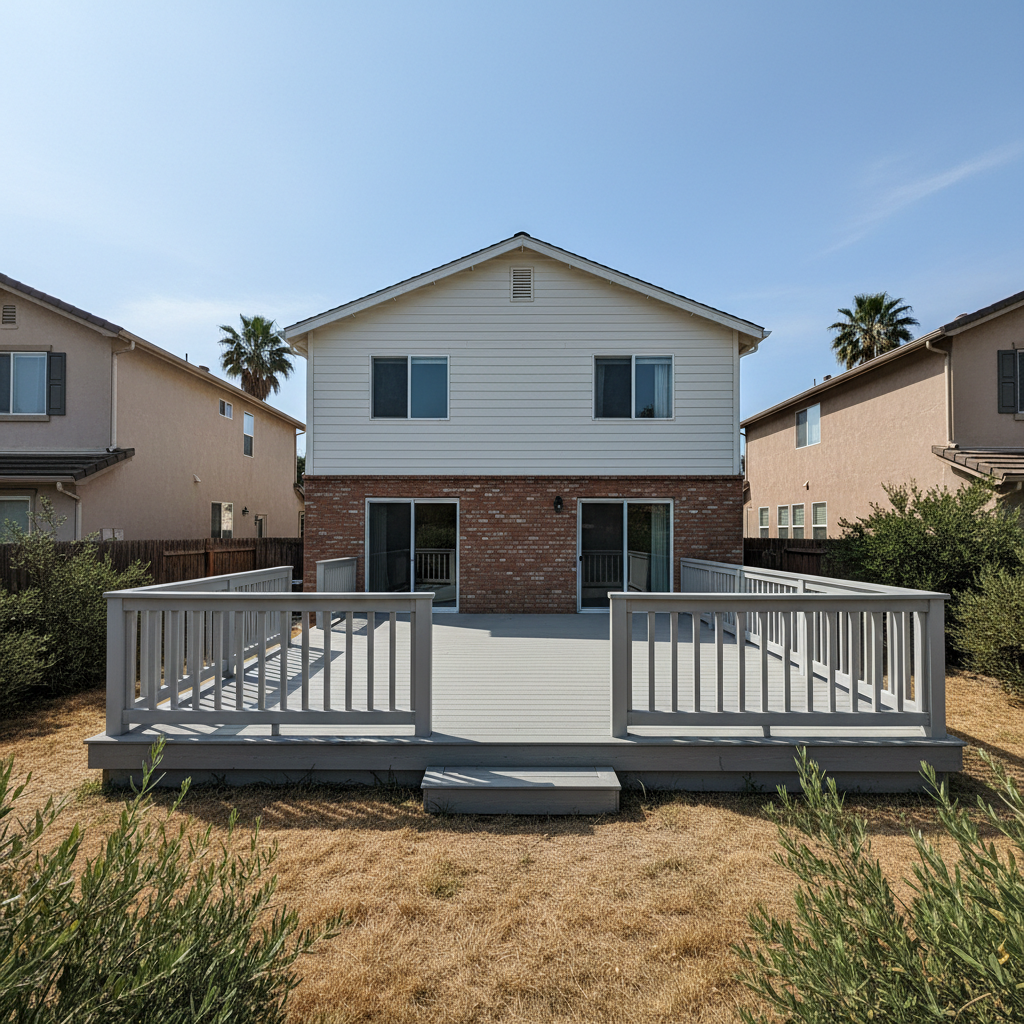
El Cajon sits in a valley that cooks in summer and barely sees rain the rest of the year. That matters more than people think when you're picking who builds your deck. A builder who's used to coastal jobs in La Mesa or Lakeside might not think twice about how a dark composite board behaves when it hits 115 degrees on the surface in August, or how fast untreated lumber dries out and checks in our low humidity. You want someone who's dealt with this valley specifically, not just decks in general.
Check the license, not the truck
Anyone can put a logo on a van. In California, deck work that involves structural framing should be done under a B (general building) or C-13 (framing/structural) contractor's license, and you can look up the number on the Contractors State License Board site in about thirty seconds. Check that it's active, check the bond, check if there are complaints on file. If a guy hesitates when you ask for his license number, that's the whole conversation right there. You don't need his life story. You need the number and five minutes on a government website.
Ask about insurance too, specifically workers' comp. If a crew member falls off a ledger board eight feet up and the contractor has no comp coverage, that liability can land on you as the homeowner. A legitimate outfit carries it and won't flinch when asked for a certificate.
Permits aren't a formality here
Most decks in El Cajon that sit more than about 30 inches above grade trigger a guardrail requirement under the California Building Code, and that height also tends to trigger a permit requirement from the city. If your lot is in unincorporated East County, like parts of Rancho San Diego or Harbison Canyon, you're dealing with San Diego County instead of the city building department, and the process differs slightly. Either way, a real inspection happens at the footing stage, before you pour, and often again at the ledger connection and the final walkthrough.
A contractor who tells you "we don't need a permit for this" on a structural deck is either wrong or hoping you won't ask again. Plan check can take a couple of weeks depending on the backlog, and that's annoying, but it's also the point where someone other than the builder looks at the span tables and the footing depth before it's buried. Skip it and you're trusting one person's math with no second set of eyes, and you may have real trouble selling the house later when a buyer's inspector asks for the permit that doesn't exist.
What's under the deck matters more than what's on top
A lot of El Cajon's older neighborhoods, Fletcher Hills, Bostonia, parts around Rancho San Diego, were built in the 1950s through the 70s, and the soil under those slabs and yards has had decades to settle. Some of it is heavy clay that swells when it gets wet in January and shrinks hard come July. A footing that doesn't get down into undisturbed soil, usually a minimum of 12 to 18 inches depending on the engineer's call, can shift with that clay over a few seasons and take your railing posts with it. On newer subdivisions with more decomposed granite or engineered fill, the footing story is different, and a builder who's actually worked your street will know which one he's dealing with before he digs the first hole.
Ask specifically how they're attaching the ledger board to the house. This is the single most common failure point in deck collapses nationally, not the decking, not the railing, the ledger. It should be lag-bolted or through-bolted into the rim joist, not just nailed, and it needs flashing behind it so water doesn't track into your house framing. If a contractor glosses over this question or hasn't thought about it, walk away. This is the part nobody sees once the boards go down, which is exactly why it's the part worth asking about before they start.
Materials: get specific, not just "wood" or "composite"
Pressure-treated lumber comes rated for different exposure, and ground-contact rated posts cost more than the standard stuff but matter if a post base sits low or gets splashed by sprinklers. Composite decking varies a lot by brand and by how it handles heat expansion, boards can grow close to half an inch across a 12-foot run in our summer swings, and a builder who doesn't leave gap allowance for that will hand you a deck that buckles by year two. Ask what brand they spec, ask about the warranty terms (most composite manufacturers offer 25 to 50 years on the boards themselves, but that warranty is often void if installed outside their spec), and ask how they handle fastening, hidden clips versus face screws changes both the look and the long-term maintenance.
Red flags worth walking away from
- A bid that's thousands less than every other quote with no explanation. Someone is cutting a corner, usually footings or lumber grade, and you won't see it until it fails.
- Cash only, no written contract. You want a scope of work, start and completion dates, payment schedule, and change-order language in writing, every time.
- No mention of permits at all, in either direction.
- A contractor who can't tell you the footing depth or ledger attachment method when you ask directly.
- Pressure to sign today. A deck is a multi-thousand-dollar structural project attached to your house. It can wait a day while you check references.
What a decent conversation sounds like
A builder worth hiring will ask you questions back. How much sun does that side of the yard get in July, because it changes what finish or decking color makes sense. Is there an HOA, which is common in some of the newer developments around Singing Hills and parts of Rancho San Diego, and which might dictate railing style or deck height before you've even picked materials. Do you want it ready to drive traffic on day one or are you fine giving a stained deck a couple of days to cure before furniture goes back on it. These aren't trick questions. They're the kind a person asks when they've actually stood in a few hundred El Cajon backyards and know the ground doesn't behave the same two streets over.
If you want a second opinion on an existing deck, or you're starting from scratch and want someone to walk the yard with you before anything's signed, that's the kind of conversation we're happy to have. You can see the range of what we handle at Cornerstone Deck Co, and there's no cost to asking the questions above before you hire anyone, us included.